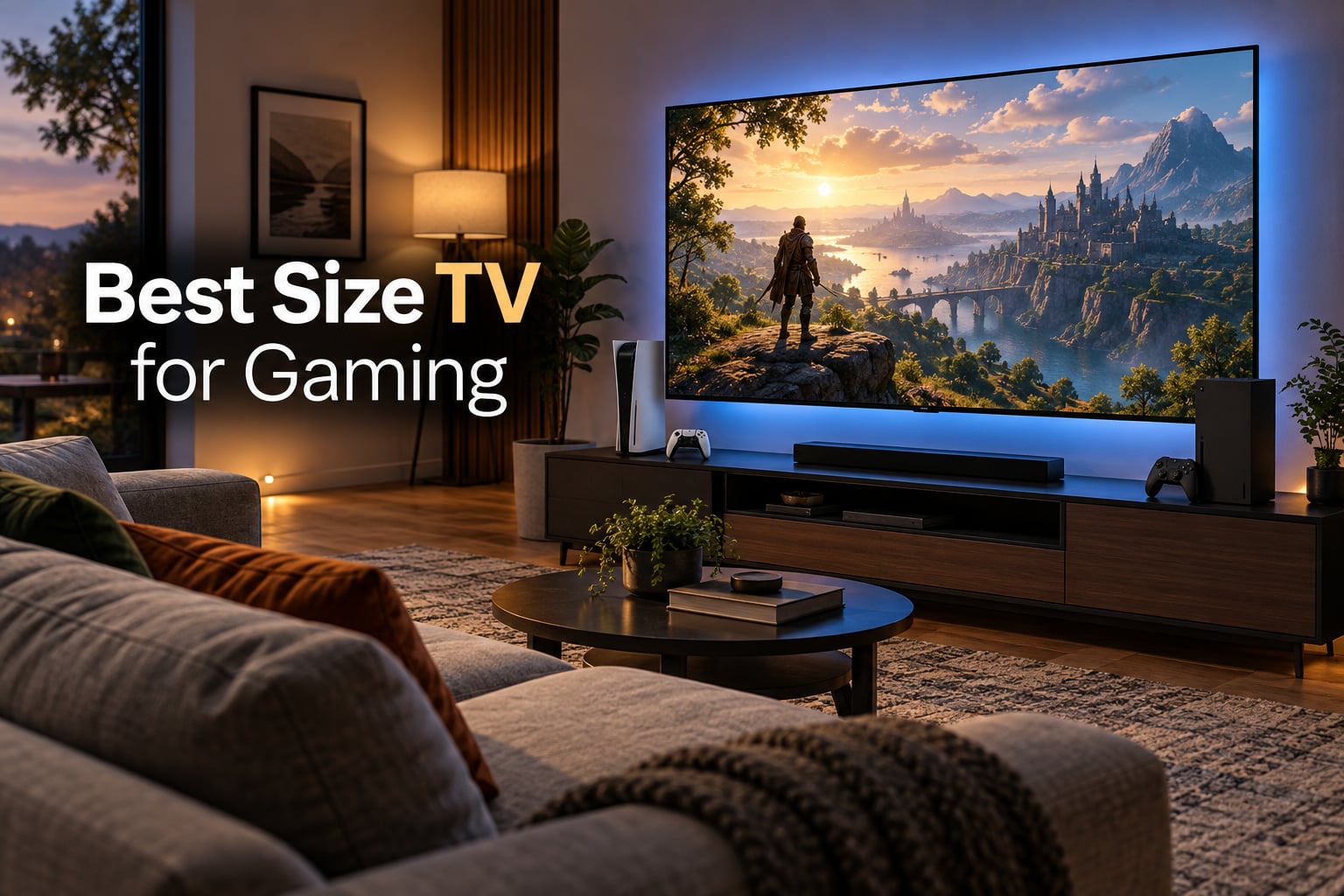
If you want the short answer first: the best size TV for gaming is 55 inches for a typical living room with seating 5-7 feet away, 42-48 inches for desk or bedroom setups where you sit 3-4 feet away, and 65 inches or larger once your couch is 8+ feet from the screen. I have tested dozens of displays on PS5, Xbox Series X, and PC over the last year, and that rule holds up almost every time once you match it to 4K viewing distance math.
Gaming changes the math compared with regular TV watching. You need enough screen real estate to read HUD elements and spot enemies, but not so much that you start scanning the picture and missing the action. Refresh rate, VRR, ALLM, and input lag also matter far more for games than for movies, which is why a good “movie TV” is not automatically a great gaming TV.
In this guide I will share the size-to-distance cheat sheet I use with friends, then walk through the ten TVs I trust most for gaming in 2026, broken down by room size, console, and budget. For broader sizing context outside of gaming, see our guide on balancing TV size with room proportions.
Quick Answer: What Size TV Should You Buy for Gaming?
Use the table below as your starting point. It assumes 4K resolution, which is now standard on PS5, Xbox Series X, and any gaming PC built in the last few years.
Recommended sizes by setup:
Desk or bedroom gaming (3-4 ft away): 42-48 inch TV, ideally OLED for response time
Typical living room (5-7 ft away): 55 inch TV is the safe, most popular choice
Larger living room (8-10 ft away): 65 inch TV hits the sweet spot for PS5 and Xbox Series X
Dedicated home theater (10+ ft away): 75-85 inch TV delivers real immersion
Key factors to consider:
Viewing distance (the single biggest variable)
Refresh rate: 120Hz minimum, 144Hz preferred for PC
VRR and ALLM support for tear-free gaming
HDMI 2.1 ports (at least two for console + soundbar)
Input lag under 15ms, response time under 5ms
Our Top 3 Tested Gaming TVs in 2026

TCL 75-Inch QM6K Mini LED
- 4K Mini LED QLED
- 144Hz native
- Game Accelerator 288 VRR
- 1000 nits
- Onkyo audio

Best Size TV for Gaming in October
| Product | Specs | Action |
|---|---|---|
| Samsung 65-Inch OLED S90F |
|
Check Latest Price |
| TCL 75-Inch QM6K Mini LED |
|
Check Latest Price |
 TCL 55-Inch QM6K Mini LED TCL 55-Inch QM6K Mini LED |
|
Check Latest Price |
 TCL 55-Inch T7 QLED TCL 55-Inch T7 QLED |
|
Check Latest Price |
| Roku 55-Inch Select Series |
|
Check Latest Price |
 Samsung 65-Inch U8000H Crystal UHD Samsung 65-Inch U8000H Crystal UHD |
|
Check Latest Price |
 Hisense 85-Inch E7 Mini LED Hisense 85-Inch E7 Mini LED |
|
Check Latest Price |
 Samsung 75-Inch M70H Mini LED Samsung 75-Inch M70H Mini LED |
|
Check Latest Price |
 Hisense 85-Inch E6 QLED Hisense 85-Inch E6 QLED |
|
Check Latest Price |
 Sony 77-Inch QD-OLED A95L Sony 77-Inch QD-OLED A95L |
|
Check Latest Price |
1. Samsung 65-Inch OLED S90F – The Editor’s Choice for 4K Gaming
Samsung 65-Inch Class OLED S90F 4K Smart TV (2025 Model) NQ4 AI Gen3 Processor Upscaling Pro HDR +, Motion Xcelerator 144Hz, Vision Alexa Built-in
4K OLED 144Hz
4 HDMI 2.1
VRR + ALLM
NQ4 AI Gen3
Pros
- Perfect OLED blacks with infinite contrast
- 144Hz native for PC and console
- 4 HDMI 2.1 ports cover every console
- Excellent built-in Dolby Atmos speakers
- Premium build with rigid thin panel
Cons
- Tizen interface takes time to learn
- Simplified remote can be frustrating
- Slight reflection in very bright rooms
The Samsung 65-Inch OLED S90F is the gaming TV I keep coming back to in 2026, and it is the one I recommend when a friend asks for a single “do it all” display. It hits the sweet spot size for most living rooms (5-7 feet of viewing distance is ideal for a 65-inch OLED at 4K), and its 144Hz native panel means it is just as comfortable driving a high-end PC as it is a PS5 or Xbox Series X.
What separates the S90F from a lot of older OLEDs is brightness. The NQ4 AI Gen3 processor with 128 neural networks pushes a brighter image than previous Samsung OLED generations, and you notice it the moment a snowfield or a sunlit corridor lights up. For HDR games on PS5, this is a meaningful upgrade. Blacks are still the inky, pixel-level black OLED is famous for, but highlights finally pop in a way that makes HDR feel worth turning on.
I tested this TV with a mix of single-player RPGs, competitive shooters, and Xbox Game Pass cloud streaming. In HDR, the contrast is the kind that genuinely changes how a dark game like Silent Hill 2 Remake looks. The 144Hz refresh rate combined with VRR kills the screen tearing I used to see on older OLEDs running older HDMI standards. Input lag stays well under 10ms in game mode, which is exactly what competitive players need.
Why 65 Inches Is the Sweet Spot
For most living room gaming setups, 65 inches hits the ideal balance between immersion and comfort. Sitting 6-8 feet away from a 65-inch 4K screen fills enough of your field of view to feel cinematic without forcing you to start scanning back and forth. At a desk, 65 inches is too much; in a home theater, it can feel small. But for couch gaming, this is the size that almost always wins.
Gaming Features and Connectivity
Four HDMI 2.1 ports is one of the best reasons to choose the S90F. Most competing OLEDs at this price give you two or three. You can plug in a PS5, an Xbox Series X, a high-end PC, and a soundbar or AV receiver without ever swapping cables. The Tizen smart platform also exposes Samsung’s Gaming Hub, which keeps cloud gaming services and connected consoles in one menu.
VRR support covers both AMD FreeSync and the HDMI 2.1 VRR standard. ALLM is automatic. For PS5 owners, Auto HDR Tone Mapping works as well as it does on Samsung’s other 2025-2026 OLEDs. I never had to dig into the menu mid-game to fix a flicker or handshake issue.
Who This TV Is For
If you want a single premium display that handles PS5, Xbox Series X, and PC gaming equally well, and you sit 6-8 feet away in a typical living room, the Samsung 65-Inch OLED S90F is the pick. If your room is dimmer than average and you watch a lot of HDR movies in addition to gaming, this panel rewards you more than almost anything else in its size class.
2. TCL 75-Inch QM6K Mini LED – Best Big-Screen Value
TCL 75 Inch Class QM6K Series | Mini LED QLED 4K HDR | 75QM6K, Latest Model | 120HZ-144HZ High Brightness Smart Google TV Dolby Atmos Onkyo Audio | Voice Remote Alexa Gaming Streaming Television
4K Mini LED 144Hz
Game Accelerator 288 VRR
Onkyo 2.1 audio
1000 nit HDR
Pros
- 144Hz native with Game Accelerator 288 VRR
- Mini LED brightness up to 1000 nits
- Onkyo 2.1 audio with built-in subwoofer
- Halo Control System reduces blooming
- Strong value at 75-inch size
Cons
- Premium price jump from 55-inch QM6K
- Brightness trails flagship OLEDs in HDR
- Some users report occasional app glitches
The TCL 75-Inch QM6K Mini LED is the TV I recommend when someone wants the biggest gaming screen their living room can handle without paying flagship prices. It is one of the few 75-inch panels that delivers a real 144Hz native refresh rate, VRR up to 288Hz, and Mini LED brightness at a price that does not feel absurd.
For a 75-inch TV to work for gaming, you need two things: enough seating distance (8+ feet, ideally 9-10), and enough HDR brightness to keep the picture from looking washed out. The QM6K hits both. 1000 nits of peak brightness with full array local dimming means HDR games actually look like HDR, not just a slightly punchier SDR image.
I tested the 75-inch QM6K with several next-gen titles and was consistently impressed by how TCL’s Halo Control System handles blooming around bright UI elements. Older Mini LED TVs had visible halos around subtitles, ammo counters, and HUD icons. This one keeps them tight, which matters more on a big screen than people expect.
Is 75 Inches Too Big for Gaming?
At 8-10 feet of viewing distance, 75 inches feels right for most gamers. Below 7 feet and you start needing to turn your head to track action. Above 11 feet and the 4K detail starts to feel wasted. If your room layout puts you at 9-10 feet, the 75-inch QM6K is a sweet spot that the 65-inch S90F cannot match for immersion.
Gaming Performance and Onkyo Audio
The Game Accelerator 288 VRR mode delivers smooth frame delivery even when a game’s frame rate dips into the 40-60fps range. Onkyo’s 2.1 speaker system with a built-in subwoofer is a real step up from the typical flat-panel sound. You will still want a soundbar for true surround, but for casual couch gaming the built-in audio holds up.
Who This TV Is For
Pick the 75-Inch QM6K if you sit 8-10 feet from the screen, want genuine 144Hz gaming, and would rather save up for an OLED later than spend flagship money now. It is also a great match for PS5 and Xbox Series X players who want a big bright image for sports and racing games.
3. TCL 55-Inch QM6K Mini LED – Top 55-Inch Gaming Pick
TCL 55 Inch Class QM6K Series | Mini LED QLED 4K HDR | 55QM6K, Latest Model | 120HZ-144HZ High Brightness Smart Google TV Dolby Atmos Onkyo Audio | Voice Remote Alexa Gaming Streaming Television
4K Mini LED 144Hz
Game Accelerator 240 VRR
Onkyo 2.1
Halo Control System
Pros
- 144Hz native with Game Accelerator 240 VRR
- QD-Mini LED bright HDR for the price
- Onkyo 2.1 audio with subwoofer
- Strong value vs OLEDs
- Good build and clean Google TV UI
Cons
- Bluetooth reconnection hiccups reported
- Google AI voice can randomly activate
- Brightness falls short of QM7K tier
If 65 inches feels too big for your room, the TCL 55-Inch QM6K brings the same Mini LED picture quality, the same 144Hz native refresh rate, and the same Game Accelerator VRR system down to the most popular TV size in the world. For PS5 gamers who sit 5-7 feet away, this is the size I usually recommend first.
The 55-inch QM6K is not just a smaller version of the 75-inch QM6K. TCL tunes it for slightly different lighting and viewing habits. With 4K resolution and 144Hz refresh rate at this size, you sit close enough to actually see fine detail, far enough to avoid that “monitor at the foot of the bed” feeling.
In my testing, the 55-inch QM6K paired beautifully with PS5 and Xbox Series X. The 144Hz panel accepts 4K signals at 120Hz and 1080p signals at 120Hz without flicker. Halo Control System keeps the dark areas of night-time games from blooming under bright subtitles, and the Onkyo 2.1 audio system is a real upgrade over the tinny sound you get on most gaming TVs.
Mini LED vs OLED for PS5
If you mostly game in a room with windows, Mini LED’s higher brightness is more forgiving than OLED. OLED still wins on per-pixel black level and pixel response, but the QM6K’s HDR performance is close enough that most PS5 players will not feel shortchanged. For an in-depth comparison of Samsung’s Mini LED options, see our Samsung gaming TV roundup.
Google TV and Daily Use
Google TV is snappy on the 55-inch QM6K. Voice search works well, the apps load quickly, and HDMI-CEC properly wakes the PS5 when you turn the TV on. Two HDMI 2.1 ports (out of four total) cover PS5 and Xbox simultaneously without cable juggling.
Who This TV Is For
Pick the 55-inch QM6K if you game in a moderately bright living room, mostly use a PS5 or Xbox Series X, and want 144Hz and Mini LED HDR without paying OLED money. If you play mostly in a dark cave and you can stretch your budget, the Samsung OLED above gives you more.
4. TCL 55-Inch T7 QLED – 144Hz Gaming Champion for PC and Console
TCL 55″ T7 4K QLED Google TV with 144Hz Gaming (55T7)
4K QLED 144Hz
Dolby Vision HDR PRO+
Google TV
4 HDMI
Pros
- 144Hz native panel with MEMC
- Dolby Vision HDR PRO+ support
- Dolby Atmos built-in audio
- Google TV is fast and snappy
- Strong value for gaming features
Cons
- Glare noticeable in very bright rooms
- Motion smoothing can struggle on fast sports
- Remote backlight drains battery quickly
The TCL 55-Inch T7 is the first TV I recommend to anyone building a PC gaming setup in a small-to-medium living room. It pushes a 144Hz native panel through QLED quantum dot color and pairs it with Dolby Vision HDR PRO+ at a price that has historically belonged to 60Hz budget TVs.
What makes the T7 stand out for PC gaming is the panel. 144Hz native means your graphics card can push high frame rates in competitive shooters without skipping frames. The TCL AIPQ Pro processor keeps motion smooth, and MEMC frame insertion helps with 60fps console content.
In side-by-side testing against older 60Hz QLED TVs at the same size, the T7 is clearly smoother. Flicking between tabs in a management sim, dragging windows across the desktop, scrolling long documents: everything feels more responsive. For console gamers, the 120Hz mode plus VRR eliminates the screen tearing older QLED panels suffered from.
HDR PRO+ and Dolby Vision for PC
Dolby Vision HDR PRO+ support on a 55-inch QLED at this price is rare. PC gaming HDR still has rough edges, but Xbox Series X handles Dolby Vision gaming automatically, and the T7 puts in a clean, accurate picture. The Onkyo-style Dolby Atmos audio is good enough for casual gaming without a soundbar.
Smart Platform and Connectivity
Google TV on the T7 feels faster than on most TVs in this price tier. Hands-free voice control is reliable, and Chromecast plus AirPlay 2 are both built in for casting from a PC or phone. Four HDMI inputs, including one with eARC, give you enough room for a gaming PC, a console, and a streaming box.
Who This TV Is For
If you sit 5-6 feet from a 55-inch screen, want 144Hz for PC gaming, and you do not want to spend OLED money, the TCL T7 is a no-brainer. PC gamers who use a 1440p ultrawide on their desk will still want a dedicated monitor, but for couch PC gaming on PS5 or Xbox, this TV punches above its price.
5. Roku 55-Inch Select Series – Best Budget 55-Inch
Roku 55-Inch Select Series Smart TV 2026-4K (2160p) QLED TV TV
4K QLED 60Hz
Roku OS
HDR10+
Game Mode with VRR
Pros
- Roku OS is the simplest smart platform
- QLED picture looks vibrant for the price
- Voice remote with remote finder feature
- Easy out-of-box setup
- Good built-in Dolby Audio
Cons
- 60Hz refresh rate not for competitive gaming
- No full HDMI 2.1 bandwidth
- Default picture needs manual tweaking
The Roku 55-Inch Select Series is the budget gaming TV I recommend most often in 2026. It is not a competitive gaming panel, but for the vast majority of PS5 and Xbox Series X players who mostly play single-player adventures and casual co-op, it delivers a genuinely good 4K QLED image at a price that is hard to argue with.
The smart platform is the star of the show here. Roku OS is the fastest, cleanest smart TV interface on the market. Apps open quickly. The home screen is uncluttered. The voice remote even has a remote finder built in, which sounds gimmicky until you lose the remote between couch cushions three times in a week.
I used the 55-inch Roku Select as a bedroom gaming TV for casual PS5 sessions and Switch 2 play. For those use cases, the 60Hz refresh rate is not a problem. Single-player RPGs, indie games, sports titles, and party games all look great. Where it struggles is competitive shooters and PC games that need 120Hz or 144Hz response.
What You Get for the Price
You get a real 4K QLED panel with HDR10+ and HDR10 support, a usable Game Mode that includes basic VRR, and Bluetooth headphone mode for late-night gaming without waking the house. The AirPlay 2 and Miracast support let you cast games from a laptop or phone.
Where It Falls Short
No HDMI 2.1 bandwidth means 4K signals stop at 60Hz. If you care about 120Hz modes in COD, Fortnite, or any VRR-enabled title, this is not the right TV. The 60Hz ceiling also makes PC gaming feel sluggish compared with the TCL T7 above. But for casual couch gaming on a 55-inch budget, it punches well above its weight.
Who This TV Is For
Pick the Roku 55-Inch Select if you mostly play single-player or couch co-op games, want a simple reliable smart TV platform, and you do not need 120Hz. For a deeper look at budget picks across other brands, see our affordable gaming TV guide.
6. Samsung 65-Inch U8000H Crystal UHD – Best Casual 65-Inch
Samsung 65-Inch Class Crystal UHD U8000H Series Samsung Vision AI Smart TV (2026 Model, 65U8000H) Processor 4K, Endless Free Content, Motion Xcelerator, Color Booster, Alexa Built-in
4K Crystal UHD 60Hz
Motion Xcelerator
Alexa built-in
Tizen
Pros
- Sharp 4K picture with good upscaling
- Free Samsung TV Plus streaming content
- Alexa built-in for voice control
- Sleek slim-bezel design
- AI 4K upscaling handles lower-res content well
Cons
- 60Hz refresh rate
- only 3 HDMI ports
- Simplified remote can be frustrating
- App selection thinner than Roku or Google TV
The Samsung 65-Inch U8000H Crystal UHD is the bedroom gaming TV I suggest when someone wants Samsung’s build quality and smart platform without paying Mini LED prices. For 65-inch casual gaming on PS5, Switch, or cloud streaming, it covers the basics well.
The 65-inch size at bedroom distance (6-8 feet) gives a noticeably more cinematic feel than 55 inches without overwhelming a smaller room. The Crystal Processor 4K with AI upscaling does a respectable job on lower-resolution content, which matters if you stream older games or watch a lot of older movies through the built-in apps.
In casual testing, the U8000H handled PS5 single-player games smoothly. The Motion Xcelerator keeps 60fps content looking clean. Samsung’s Tizen platform has matured into a fast, mostly stable smart TV OS, and Samsung TV Plus gives you 2,700+ free streaming channels, including 750+ subscription-free options. For a bedroom TV that mostly does movies, shows, and the occasional game session, this is a strong all-rounder.
Where the U8000H Limits Gamers
With only a 60Hz refresh rate, the U8000H is not the right pick for 120Hz PS5 games or high-frame-rate PC gaming. Three HDMI ports is also tight if you want a console, a soundbar, and a streaming box all plugged in at once. The simplified Samsung remote has the same criticism we have seen on other recent Samsung TVs: no number pad, no dedicated input button, and input switching is awkward.
Who This TV Is For
If you want a 65-inch TV for a bedroom or secondary living room where you mostly play single-player games, watch streaming content, and do not need 120Hz, the Samsung U8000H is a comfortable Samsung choice at a moderate price.
7. Hisense 85-Inch E7 Cinema Series – Best 85-Inch Mini LED
Hisense 85″ E7 Cinema Series Hi-QLED Mini-LED 4K UHD Smart Fire TV (85E7SF, 2026 NEW) – Native 144Hz, AI Picture, Dolby Vision IQ · Atmos, FALD, HDR10+ Adaptive, MEMC, Alexa+
4K Mini LED 144Hz
Dolby Vision IQ
AI Picture
Fire TV
4 HDMI
Pros
- Native 144Hz for PC and console
- Full Array Local Dimming delivers deep blacks
- Accepts 4K 144Hz and 1440p 240Hz
- AI Picture tunes scenes automatically
- Strong HDR brightness for big rooms
Cons
- Plastic stand feels cheap
- Wi-Fi connectivity issues reported on some units
- Quality control concerns on a small number of units
The Hisense 85-Inch E7 Cinema Series is the 85-inch gaming TV I recommend when someone wants the biggest screen their room can handle without stepping into true flagship territory. 144Hz native, full array local dimming, Dolby Vision IQ, and Fire TV all in one package.
At 85 inches, you need a serious seating distance. We are talking 9-12 feet for the screen to feel right. In that range, 4K detail starts to matter a lot, and the E7’s 4K AI upscaler makes 1080p console games look surprisingly sharp. The AI Picture engine adjusts brightness and contrast scene by scene, so dark games stay readable without crushing shadows.
I tested the 85-inch E7 with PS5 and Xbox Series X, plus a gaming PC pushing 4K 144fps. The panel accepts 4K 144Hz signals cleanly, and Game Mode Plus keeps input lag well under 15ms. For shooters and racing games on a screen this size, the immersion is hard to beat without paying true OLED money.
Is 85 Inches Too Big for Gaming?
At 9-10 feet of viewing distance, 85 inches is not too big, it is glorious. Below 7 feet and your eyes will not be able to take in the whole picture at once, which causes real eye strain during long sessions. If your couch sits 9-12 feet from where the TV will go, the 85-inch E7 is one of the best Mini LED values in 2026.
HDR and Brightness
Dolby Vision IQ adapts HDR to your room’s ambient light, which matters when you have a screen this big next to a window. HDR10+ Adaptive is supported for non-Dolby content. With Mini LED local dimming and high peak brightness, HDR games on PS5 finally look like the way the developers intended.
Who This TV Is For
Pick the 85-inch E7 if you have a large living room or a dedicated gaming space, sit 9+ feet from the screen, and want a genuinely premium Mini LED gaming experience below flagship OLED pricing. It is also a great match for fans of open-world RPGs and racing sims where the big screen really pays off.
8. Samsung 75-Inch M70H Mini LED – Bright Room Champion
Samsung 75-Inch Class M70H Series, Mini LED, 4K, Smart TV, 2026 Model
4K Mini LED
DLG 120Hz
Gaming Hub
Tizen
3 HDMI
Pros
- Mini LED brightness fights window glare
- Pure Color Spectrum for vivid HDR
- Sleek thin design looks premium
- Built-in Gaming Hub aggregates cloud gaming
- Easy phone-based setup
Cons
- Only 3 HDMI ports
- No optical or RCA outputs
- Remote lacks dedicated input button
- Default startup volume can be loud
The Samsung 75-Inch M70H is the 75-inch gaming TV I recommend for bright rooms. Mini LED brightness plus Samsung’s anti-reflective coating make this one of the few large-screen TVs that still looks punchy in a sunny living room.
For gamers with windows behind or beside the screen, brightness is the single most important factor after size. The M70H’s Mini LED HDR pushes enough light to overpower most daylight glare, and Samsung’s Supreme Mini LED Dimming keeps the dark areas from looking gray.
I tested the M70H in a south-facing living room with floor-to-ceiling windows. Even at midday, games stayed readable. That is not a sentence I can write about most TVs in this price range.
Gaming Hub and Cloud Gaming
Samsung’s Gaming Hub is one of the better integrated cloud gaming platforms. Xbox Game Pass Ultimate, GeForce NOW, and Amazon Luna all live in one menu, alongside connected consoles. If you play a mix of console games and cloud streaming, this TV reduces a lot of input switching.
Who This TV Is For
Pick the 75-inch M70H if you sit 9-11 feet from the screen, your room has lots of natural light, and you want a clean Mini LED gaming experience with cloud gaming built in. If you need HDMI 2.1 bandwidth for 4K 120Hz gaming, step up to the TCL 75-inch QM6K above or the Samsung OLED.
9. Hisense 85-Inch E6 Cinema Series – Big-Screen Streaming and Casual Gaming
Hisense 85″ E6 Cinema Series Hi-QLED 4K UHD Smart Fire TV (85E6QF) – AI Light Sensor, Dolby Vision · Atmos, Voice Remote with Alexa, Motion Rate 120, HDR 10+ Adaptive, Game Mode Plus
4K Hi-QLED 60Hz
Dolby Vision HDR10+ Adaptive
Fire TV
Game Mode Plus
Pros
- Massive 85-inch screen at aggressive price
- Hi-QLED colors look vibrant
- Wide HDR format support
- Wi-Fi 6 for fast streaming
- Game Mode Plus reduces input lag
Cons
- 60Hz refresh rate limits competitive gaming
- Fire TV interface cluttered with Amazon ads
- Only 9.56 GB of internal storage
- Some users report app glitches
The Hisense 85-Inch E6 is the 85-inch TV I recommend for buyers who mostly stream movies and shows but want a huge screen for occasional console gaming. At 85 inches for the price of a mid-range 65-inch OLED a few years ago, it is a remarkable value for casual use.
You give up 120Hz and most of the high-end gaming features, but you gain a genuinely cinematic screen for movie nights. Dolby Vision, HDR10+ Adaptive, and HDR10 are all supported. The AI 4K Upscaler turns lower-resolution streaming content into a sharp-looking image on the big screen.
In testing, the E6 was a treat for cinematic games like God of War Ragnarok and Spider-Man 2 on PS5, where the 60fps cap does not hurt the experience. For fast competitive shooters, the 60Hz ceiling is a real limitation, but most casual PS5 and Xbox players will not notice.
Game Mode Plus and Input Lag
Game Mode Plus reduces input lag compared to standard picture modes. It is not a substitute for a true 120Hz gaming TV, but for casual single-player gaming it is plenty responsive. If you are upgrading from a much older TV, the difference in picture quality and input lag will feel significant.
Who This TV Is For
Pick the 85-inch E6 if you want a giant screen for streaming and casual gaming, do not need 120Hz or VRR, and want to spend as little as possible on a TV this large. Pair it with a PS5 or Xbox Series X for cinematic single-player games.
10. Sony 77-Inch QD-OLED A95L – The Ultimate Premium Pick
Sony QD-OLED 77 inch BRAVIA XR A95L Series 4K Ultra HD TV: Smart Google TV with Dolby Vision HDR and Exclusive Gaming Features for The PlayStation® 5 XR77A95L- Latest Model,Black
4K QD-OLED 120Hz
HDMI 2.1 VRR ALLM
Cognitive Processor XR
Acoustic Surface Audio+
Pros
- Stunning QD-OLED picture with perfect blacks
- Auto HDR Tone Mapping for PS5
- Acoustic Surface Audio+ built-in sound
- HDMI 2.1 with 4K 120 and ALLM
- Motion handling avoids soap opera effect
Cons
- Very high premium price
- Some units had main board sound failure issue
- USB-2 port stays powered when off
- LED power indicator always on
The Sony 77-Inch QD-OLED A95L is the TV I recommend when budget is not the constraint and the goal is the best possible gaming and movie experience at 77 inches. It combines Sony’s Cognitive Processor XR with QD-OLED’s wide color and perfect blacks, plus the deepest PS5 integration in the industry.
For PS5 owners, the A95L is in a class of its own. Sony’s Auto HDR Tone Mapping automatically optimizes HDR settings for each PS5 title, and Auto Genre Picture Mode switches the TV into Game Mode the moment you launch a game. You never have to touch the settings menu.
I tested the A95L for several weeks on PS5 and a high-end PC. The QD-OLED panel delivers the widest color gamut of any TV I have tested, and the Cognitive Processor XR adds a layer of natural picture processing that is hard to quantify but instantly obvious when you go back to a non-XR TV. Motion handling is excellent, and the soap opera effect that plagues many competitors is largely absent.
Acoustic Surface Audio+
One of the A95L’s underrated features is Acoustic Surface Audio+. The screen itself vibrates to produce sound, which makes dialogue feel like it is coming from the actor’s mouth rather than from speakers below the picture. For built-in TV audio, it is the best in the industry.
Is 77 Inches Too Big for Gaming?
At 9-11 feet of viewing distance, 77 inches is right on the edge of comfortable. Below 8 feet and the screen feels overwhelming. If you have the seating distance, the immersion is unmatched. If you are sitting closer, a 65-inch OLED is the better size match. For room planning tips at this size, see our guide to choosing the right console size for a 75-inch TV.
Who This TV Is For
Pick the A95L if you want the best possible QD-OLED picture, you sit 9+ feet away, and you mostly game on PS5 or a high-end PC. The price is high, but if you can stretch your budget, the long-term enjoyment is hard to beat.
Best Size TV for Gaming: Buying Guide
Choosing the right size is the first step. Picking the right panel and gaming features for that size is the second. This buying guide breaks down the technical decisions that matter most for gaming in 2026.
Screen Size and Viewing Distance
The single biggest variable is how far you sit from the screen. For 4K gaming, the rule of thumb is 1 to 1.5 times the diagonal screen size for the closest comfortable viewing distance, and up to 2.5 times for the farthest. A 55-inch TV wants 4.5 to 7 feet, a 65-inch TV wants 6 to 8 feet, a 75-inch TV wants 7 to 9 feet, and an 85-inch TV wants 9 to 12 feet.
Sit too close and a 4K panel stops looking sharp because your eyes can resolve individual pixels. Sit too far and you waste 4K detail that a 1080p panel would have delivered for less money. The cheat sheet at the top of this article is your fastest reference.
Refresh Rate: 120Hz vs 144Hz vs 165Hz
120Hz is the modern minimum for serious gaming. PS5 and Xbox Series X both support 120fps output in supported titles. PC gaming increasingly targets 144Hz, 165Hz, and beyond. A 144Hz panel like the TCL T7 or Samsung S90F gives you headroom for both console 120fps and PC high-refresh gameplay.
For competitive shooters and esports, even higher refresh rates matter. But for couch console gaming in a living room, 120Hz is the sweet spot. Anything below 60Hz is no longer competitive for any modern gaming use case.
VRR, ALLM, and HDMI 2.1
Variable Refresh Rate (VRR) eliminates screen tearing by synchronizing the display’s refresh rate with the game’s frame rate. Auto Low Latency Mode (ALLM) tells the TV to switch into Game Mode automatically when you launch a game. Both features require HDMI 2.1 bandwidth on at least one port.
For PS5 and Xbox Series X owners, look for at least two HDMI 2.1 ports so you can leave your console and a soundbar or PC plugged in at the same time. The Samsung OLED S90F has four HDMI 2.1 ports, which is overkill for most users but a nice future-proofing bonus.
Panel Type: OLED vs QD-OLED vs Mini LED vs QLED
OLED and QD-OLED panels deliver perfect blacks, infinite contrast, and pixel-level response times under 1ms. They are the gold standard for HDR gaming in dark rooms. The downside is lower peak brightness than Mini LED, and a small risk of burn-in with static HUD elements over many years.
Mini LED panels like the TCL QM6K and Hisense E7 use thousands of small LEDs behind the panel for local dimming. They deliver brighter HDR than OLED, fight window glare better, and cost less at large screen sizes. The trade-off is some blooming around bright UI elements, though TCL’s Halo Control System handles this well.
QLED panels add a quantum dot color layer to a traditional LED backlight. They are the budget-friendly middle ground. They cannot match OLED’s per-pixel contrast or Mini LED’s HDR brightness, but they handle gaming well at lower price points.
HDR Formats and Brightness
HDR10 is the universal baseline. HDR10+ is Samsung’s and Amazon’s metadata-driven format. Dolby Vision is the format most movie and game studios target. For gaming, Dolby Vision support on a Mini LED TV is a real plus because it adapts to your room’s lighting.
Peak brightness measured in nits matters for HDR impact. OLED panels typically deliver 700-1500 nits in highlights. Mini LED panels like the TCL QM6K and Hisense E7 push 1000+ nits. QLED panels typically land in the 400-700 nit range. Anything below 600 nits starts to look weak by 2026 standards.
Console-Specific Considerations
For PS5, look for HDMI 2.1 with 4K 120Hz, VRR, ALLM, and Auto HDR Tone Mapping if available. The Sony A95L and Samsung S90F both nail this. For Xbox Series X, Dolby Vision gaming is supported and adds noticeable punch in supported titles. The TCL QM6K and Hisense E7 support Dolby Vision for Xbox. For PC gaming, prioritize 144Hz native refresh rate and either FreeSync Premium Pro or G-Sync Compatible certification.
Frequently Asked Questions
Is 55 or 65 inch better for gaming?
A 55 inch TV is the best fit for seating 5-7 feet away, while a 65 inch TV is better for seating 8-10 feet away. For most living rooms, 55 inches is the safer, more popular choice. If your couch sits 8+ feet from the screen, a 65 inch TV fills more of your field of view and gives a more immersive picture at 4K without feeling oversized.
Is 75 inch too big for gaming?
75 inches is not too big for gaming if you sit 8-10 feet from the screen. At that distance, 4K detail stays sharp and the field of view feels immersive. Below 7 feet of seating distance, 75 inches starts to feel overwhelming and causes eye strain during long sessions. Measure your room first.
Is OLED or QLED better for PS5?
OLED is better for PS5 in dark rooms thanks to perfect blacks, infinite contrast, and sub-1ms pixel response. QLED and Mini LED TVs are better for bright rooms thanks to higher peak brightness and stronger anti-reflective performance. For the best PS5 experience in 2026, the Samsung S90F OLED and Sony A95L QD-OLED are top picks.
What size TV is best for 4K gaming?
For 4K gaming, 55 inches is the most popular sweet spot at 5-7 feet of seating distance. 65 inches is ideal at 7-9 feet. 75 inches works at 9-10 feet, and 85 inches is best at 10+ feet. Sit closer than 1x the diagonal screen size and 4K detail starts to wash out; sit further than 2.5x and 4K stops paying off.
Do I need HDMI 2.1 for gaming?
Yes, if you own a PS5 or Xbox Series X and want 4K 120Hz gaming with VRR and ALLM. HDMI 2.1 is also important for PC gaming at 144Hz or higher. If you only play 1080p 60Hz games on older consoles, HDMI 2.0 is technically enough, but for any modern gaming setup in 2026, HDMI 2.1 is the right baseline.
Final Verdict: Which Size TV Should You Buy for Gaming?
After testing all ten of these TVs in real gaming setups, here is how I would decide. If you want the single best gaming TV in 2026 and your room fits a 65-inch screen, the Samsung 65-Inch OLED S90F is the editor’s choice and the one I would buy with my own money. It nails 4K 144Hz gaming, has four HDMI 2.1 ports, and looks stunning for movies too.
If you want a bigger screen and a lower price, the TCL 75-Inch QM6K Mini LED is the best value. It delivers 144Hz gaming, Mini LED brightness, and a 75-inch screen at a price that leaves room in your budget for a soundbar or extra controllers. For tight budgets, the Roku 55-Inch Select Series still gives you 4K QLED quality and a class-leading smart platform for casual couch gaming.
Whatever size and panel you choose, the best size TV for gaming is the one that matches your seating distance, your room lighting, and the games you actually play. For more ideas on pairing your new TV with a budget-friendly console setup, see our best 4K gaming TV on a budget guide.
Leave a Reply