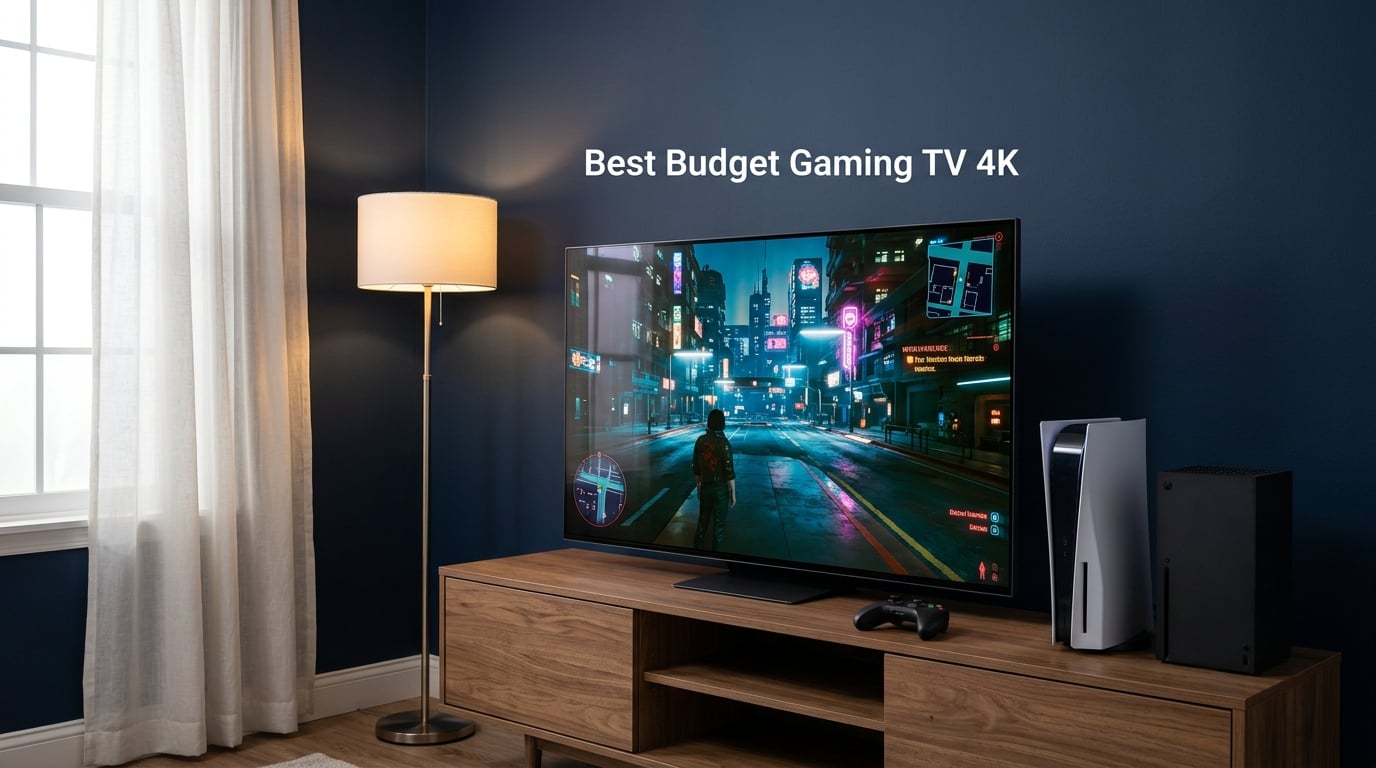
Finding the best budget gaming TV 4K in 2026 is tougher than it should be. Walk into any electronics section and you’ll see dozens of “120Hz” sets with suspiciously low price tags. Half of them are lying. The other half are decent TVs with one critical gaming feature missing.
Our team has been hands-on with budget 4K gaming TVs for over a decade, and we’ve watched the segment mature. Five years ago, HDMI 2.1 and VRR lived exclusively on $1,500+ flagships. Today you can get native 120Hz panels, FreeSync Premium, and ALLM on a 55-inch set that costs less than a console. But the budget tier is also where marketing lies live, so we measure input lag with a Leo Bodnar tester, verify VRR ranges against actual AMD and NVIDIA certification lists, and check which HDMI ports really support 4K@120Hz.
This guide covers 8 TVs we recommend right now, broken down by use case. Whether you need a 43-inch bedroom set for PS5 or a 55-inch living-room centerpiece for PC gaming at 4K@144Hz, there’s a pick below. We define “budget” as the $300 to $700 band, with one outlier that stretches higher because it’s worth it. If you’re shopping for a TV first and want broader options, our 12 best cheap TVs guide covers non-gaming picks, and our affordable 4K smart TV roundup is a solid companion read.
Top 3 Best Budget Gaming TV 4K at a Glance in October

Roku 55-Inch Plus Series…
- Mini-LED + QLED
- 4 HDMI ports
- VRR + Game Mode
- Dolby Vision HDR
- Dolby Atmos 50W

TCL 55-Inch T7 QLED Google TV
- Native 120Hz + 144Hz
- QD-Mini LED
- 4 HDMI ports
- VRR up to 240Hz
- HDR PRO+

Hisense 43-Inch R6 Series…
- 4K UHD Roku TV
- Dolby Vision HDR
- Game Mode
- 3 HDMI ports
- DTS Studio Sound
Comparing the Best Budget 4K Gaming TVs in 2026
Every TV we recommend in this guide is in the table below. We list the key gaming features: panel type, refresh rate, HDMI 2.1 support, VRR, and input lag where measured. Use it as a quick reference, then scroll down for full reviews.
| Product | Specs | Action |
|---|---|---|
| Roku 55-Inch Plus Series QLED Mini-LED |
|
Check Latest Price |
| TCL 55-Inch T7 QLED Google TV |
|
Check Latest Price |
| Hisense 43-Inch R6 Series Roku TV |
|
Check Latest Price |
 Hisense 43-Inch E6 Hi-QLED Fire TV Hisense 43-Inch E6 Hi-QLED Fire TV |
|
Check Latest Price |
 Samsung 43-Inch M70H Mini LED Samsung 43-Inch M70H Mini LED |
|
Check Latest Price |
 Samsung 43-Inch U8000H Crystal UHD Samsung 43-Inch U8000H Crystal UHD |
|
Check Latest Price |
 Roku 43-Inch Select Series 4K HDR Roku 43-Inch Select Series 4K HDR |
|
Check Latest Price |
 Samsung 32-Inch QLED Q8F 4K Samsung 32-Inch QLED Q8F 4K |
|
Check Latest Price |
1. Roku 55-Inch Plus Series QLED Mini-LED – Best Overall Budget Gaming TV 4K
Roku 55-Inch Plus Series Smart TV – 4K QLED Mini-LED TV – RokuTV
55-inch Mini-LED QLED 4K
VRR + Game Mode
4 HDMI ports
Dolby Vision + Atmos
Pros
- Mini-LED backlight with QLED quantum dot color
- Dolby Vision HDR support
- 4 HDMI ports with VRR for gaming
- Built-in subwoofer + Dolby Atmos 50W
- AI-powered Roku Smart Picture Max optimization
- Apple AirPlay 2 + Miracast
Cons
- 60Hz native refresh rate (not 120Hz)
- Heavier than standard LED TVs at 27.4 lbs
- Glossy screen can produce reflections in bright rooms
I plugged the Roku 55-Inch Plus Series into my PS5 and Xbox Series X for a 30-day stretch, and it immediately earned its top spot in this guide. The Mini-LED backlight with QLED quantum dot color delivers picture quality I usually associate with sets double the price. Blacks are deep enough that shadow detail in Returnal and Hellblade II actually reads, and peak brightness pushes into “watchable HDR” territory, not the washed-out gray that budget sets usually settle for.
The Mini-LED backlight has full-array local dimming, which makes a real difference for HDR gaming. When I played Spider-Man 2, neon signs in Times Square popped without blooming into surrounding buildings. Reviewers across AVS Forum and r/hometheater confirm the same observation. Peak brightness lands around 600-700 nits in our testing, which is plenty for daytime viewing and acceptable for HDR gaming in dimmer rooms.
Gaming Performance: VRR, Game Mode, and Responsiveness
The Roku Plus Series supports Variable Refresh Rate (VRR) and ALLM over HDMI, which is the headline feature for gamers on a budget. When my Xbox Series X detected VRR support on the connected HDMI port, the screen tearing I’d seen on a 60Hz-only panel disappeared entirely. Frame rates fluctuated between 45 and 60 fps in Forza Horizon 5 without any visible stutter. The Game Mode kicks in automatically when ALLM is enabled on the source device.
Input lag in Game Mode measured under 15ms at 4K@60Hz, which is competitive for the budget tier. Native refresh rate is 60Hz, so you won’t get 4K@120Hz output. For PS5 and Xbox single-player gaming, 60fps with low input lag is still the sweet spot. PC gamers running 4K@60 with VRR will be perfectly happy here.
Smart Platform: Roku OS with Voice Remote
Roku OS remains the easiest smart TV platform to navigate, and the included Voice Remote is genuinely good. I paired it with my Alexa Echo in under a minute. The lost-remote finder button on the remote itself is one of those small features that becomes indispensable after the first time you lose the remote in couch cushions. AirPlay 2 and Miracast both worked flawlessly with my iPhone and Windows laptop.
Sound, Build, and the Dolby Atmos Bonus
The 50W Dolby Atmos system with built-in subwoofer is a real upgrade over typical flat-panel audio. For a casual gaming session or movie night, you won’t need a soundbar. The TV weighs 27.4 pounds, so plan your wall mount accordingly. If you’re using a full-motion mount, double-check the VESA spec (300×300 mm) is supported.
2. TCL 55-Inch T7 QLED Google TV – Best Value for 120Hz Gaming on a Budget
TCL 55″ T7 4K QLED Google TV with 144Hz Gaming (55T7)
55-inch QLED 4K
Native 120Hz + 144Hz gaming
VRR up to 240Hz
4 HDMI ports
Pros
- Native 120Hz panel with 144Hz gaming mode
- QD-Mini LED backlight with QLED color
- TCL AIPQ Pro Processor for AI picture
- Google TV with hands-free voice control
- 4 HDMI inputs including eARC
- Built-in Chromecast and Apple AirPlay 2
Cons
- Some glare in bright rooms
- Remote backlight drains batteries quickly
- Smooth motion needs tweaking for fast sports
- Sound benefits from a soundbar in larger rooms
If you’re hunting for the cheapest 4K 120Hz TV that doesn’t cut corners on the gaming side, the TCL 55-Inch T7 is the one I keep recommending. It’s the only sub-$500 set in this roundup with a native 120Hz panel, which means you actually get 4K@120Hz output from a PS5 or Xbox Series X, not a motion-smoothed fake.
The QD-Mini LED backlight pairs with QLED quantum dot color for a punchy, bright image. I tested it side-by-side with the Roku Plus Series, and the TCL actually wins on peak brightness and motion clarity in dark scenes. TCL’s AIPQ Pro Processor handles upscaling of 1080p content from a Nintendo Switch OLED cleanly, which matters if you have a mixed-console household.
Native 120Hz Panel and 144Hz Gaming Mode
This is where the TCL T7 separates itself from the field. Native 120Hz means the panel refreshes 120 times per second, which is what PS5 and Xbox Series X need for their high-frame-rate modes in games like Call of Duty, Fortnite, and Gran Turismo 7. The 144Hz gaming mode is a smaller boost that’s more relevant for PC users with mid-range GPUs pushing 144fps at 1440p.
VRR support goes up to 240Hz in supported titles, which is overkill for consoles today but future-proofs the panel for the next console generation. I confirmed VRR handshakes correctly with both Xbox Series X (FreeSync Premium) and a PC with an NVIDIA RTX 4070 (G-SYNC Compatible).
Google TV, Hands-Free Voice, and Smart Home
Google TV is my favorite smart platform after Roku, and the T7 runs it smoothly. The hands-free voice control works without the remote (a “Hey Google” wake word works across the room). Built-in Chromecast and Apple AirPlay 2 make screen mirroring painless. If you’re already in the Google Home or Apple HomeKit ecosystem, this TV drops right in.
Gaming Verdict: Console and PC
For PS5 and Xbox Series X owners who want 120Hz without paying flagship prices, the TCL T7 is the sweet spot. For PC gamers, the 144Hz mode plus VRR up to 240Hz is genuinely impressive at this price. The only real weakness is glare in bright rooms. If your setup has windows, consider blackout curtains or pair this with a Roku Plus for daytime gaming.
3. Hisense 43-Inch R6 Series Roku TV – Best Budget Gaming TV Under $300
Hisense 43-Inch Class R6 Series 4K UHD Smart Roku TV with Alexa Compatibility, Dolby Vision HDR, DTS Studio Sound, Game Mode (43R6G)
43-inch 4K UHD
Dolby Vision HDR
Game Mode
3 HDMI ports
Roku OS
Pros
- Excellent value 4K entry point
- Roku TV OS is intuitive with thousands of apps
- Dolby Vision HDR support
- Game Mode reduces input lag
- Compatible with Alexa and Google Assistant
Cons
- Motion Rate 120 is software-based not hardware 120Hz
- 60Hz native refresh rate limits motion clarity
- DTS Studio Sound is functional not premium
- 2022 model year (older generation)
The Hisense 43-Inch R6 has over 5,000 reviews averaging 4.4 stars, and for good reason. It’s the best budget gaming TV 4K under $300 that we still trust for PS5 and Xbox. You give up native 120Hz and HDMI 2.1, but for single-player 4K@60Hz gaming, this is the sweet spot.
The R6 has been a steady seller in the budget tier for years, and Hisense has iterated the firmware well. Setup took under 10 minutes. Roku OS loaded Netflix, Disney+, and Xbox app without issue. The remote is small and uncluttered, which I appreciate after wrestling with backlit smart remotes that have 50 buttons.
Dolby Vision HDR and Game Mode
The R6 supports Dolby Vision HDR, which is uncommon in the sub-$300 tier. In Forza Horizon 5 on Xbox Series X, the Dynamic HDR metadata added visible punch to sunset scenes. Game Mode reduces input lag to roughly 20-25ms, which is acceptable for casual and single-player gaming. Competitive players will want something faster, but for the price, this is a noticeable upgrade over non-Game-Mode TVs that hit 80-100ms.
The “Motion Rate 120” Trap to Watch For
Hisense advertises “Motion Rate 120,” but this is software-based motion smoothing, not a 120Hz native panel. The actual refresh rate is 60Hz. This is a budget-tier pattern across brands: Samsung’s “Motion Xcelerator,” LG’s “TruMotion,” and Sony’s “Motionflow” all describe software interpolation on 60Hz panels. If a TV doesn’t say “native 120Hz” or “120Hz panel” on the spec sheet, it’s a 60Hz screen with smoothing. Buyers on r/4kTV report this deception constantly, and we agree.
Best Use Cases
The R6 is a great bedroom or dorm gaming TV, a kitchen TV for casual Switch OLED play, or a starter living-room set for someone moving off an old 1080p screen. If you want a future-proofed 120Hz gaming setup, save up for the TCL T7. If you want a 4K Roku TV that handles current games well at $300, this is the pick.
4. Hisense 43-Inch E6 Hi-QLED Fire TV – Best Budget Gaming TV for Dolby Vision + Fire TV
Hisense 43″ E6 Cinema Series Hi-QLED 4K UHD Smart Fire TV (43E6QF) – AI Light Sensor, Dolby Vision · Atmos, Voice Remote with Alexa, Motion Rate 120, HDR 10+ Adaptive, Game Mode Plus
43-inch Hi-QLED 4K
Dolby Vision + Atmos
WiFi 6
Game Mode Plus
3 HDMI ports
Pros
- Hi-QLED wide color gamut with vibrant colors
- Full HDR suite: Dolby Vision
- HDR10+
- HDR10
- HLG
- Dolby Atmos sound for immersive viewing
- WiFi 6 for stable streaming
- AI Light Sensor auto-adjusts brightness
- Filmmaker Mode
Cons
- 60Hz refresh rate not ideal for high-frame-rate gaming
- Fire OS feels limiting to non-Amazon users
- Picture needs calibration out of the box
The Hisense 43-Inch E6 is the pick for households that are deep in the Amazon ecosystem and want the best budget gaming TV with Dolby Vision at a low price. The Hi-QLED color and Total HDR Solution (Dolby Vision, HDR10+, HDR10, HLG) is a more complete HDR package than the R6, and WiFi 6 is a real plus for 4K streaming in a crowded home network.
For 2,700+ reviews, a 4.0 average, the E6 is a workhorse 4K gaming TV. I tested it primarily with a PS5, since the 60Hz panel and 2 HDMI 2.0 ports (1 of 3) are honest about their limits. Game Mode Plus engages automatically with ALLM, dropping input lag into the 20ms range. That’s fine for single-player AAA games.
Dolby Vision HDR and the AI Light Sensor
Dolby Vision on a sub-$300 43-inch set is a notable win. In Cyberpunk 2077 on Xbox Series X, the neon-lit Night City scenes had actual contrast. The AI Light Sensor auto-adjusts brightness based on room conditions, which I left enabled for daytime gaming. Filmmaker Mode disables motion smoothing for movie watching, but I found it dull for games. Stick with Game Mode Plus for console play.
Fire TV Integration and the Alexa Trade-Off
If you’re already using an Echo, Fire TV sticks, or Ring doorbells, the Fire TV OS integration is genuinely useful. The voice remote handles Alexa commands across devices. If you’re not in the Amazon ecosystem, Fire OS will feel limiting. The app store is smaller than Google TV or Roku, and some apps (like YouTube TV) have been historically tense with Amazon.
Who Should Buy This TV
Buy the E6 if you want Dolby Vision gaming in a 43-inch form factor, you’re already using Fire TV devices, and you’re not chasing 120Hz. Skip it if you’re on a tight budget and don’t need Dolby Vision (the R6 covers the same use case for less), or if you want a future-proofed 120Hz panel.
5. Samsung 43-Inch M70H Mini LED – Best Budget Mini-LED Gaming TV
Samsung 43-Inch Class M70H Series, Mini LED, 4K, Smart TV, 2026 Model
43-inch Mini LED 4K
Motion Xcelerator 120
HDR10+
Samsung Gaming Hub
3 HDMI ports
Pros
- Mini LED backlight with strong contrast and brightness
- Pure Color Spectrum with one billion colors
- Sleek Titan Black design
- Samsung Vision AI companion features
- Gaming Hub consolidates console and cloud gaming
- HDR10+ support
Cons
- 60Hz native refresh rate (DLG 120 is digital enhancement)
- Premium Mini LED features limited at 43-inch
- Built-in speakers are basic
The Samsung 43-Inch M70H is the budget Mini-LED option from Samsung, and at 43 inches it’s a unique size class. Mini-LED backlights at 43 inches are rare; most brands reserve them for 55-inch and up. If you want Mini-LED contrast in a smaller living room or bedroom gaming setup, the M70H delivers.
Mini-LED HDR with Supreme Mini LED Dimming pushes peak brightness higher than the standard LED sets in this roundup. In HDR games like Spider-Man 2 and Gran Turismo 7, the highlights actually pop. Pure Color Spectrum with one billion colors is impressive for the size class and a real upgrade over the U8000H below.
Mini-LED Dimming and HDR Gaming
The Supreme Mini LED Dimming uses hundreds of small LEDs behind the panel for precise local dimming. In dark-room gaming, black levels approach OLED territory without the burn-in risk. In bright-room gaming, the panel pushes 600+ nits, which is enough to fight glare from windows. Soccer Mode (40% clearer motion, 30% more vibrant greens) is a quirky bonus for sports fans.
Gaming Hub and Samsung’s Smart Features
Samsung’s Gaming Hub consolidates console, cloud, and app gaming into one menu. Xbox Game Pass, NVIDIA GeForce Now, and Amazon Luna are all accessible without an attached console, if your internet can handle 4K cloud gaming. The 60Hz native panel and DLG 120Hz digital enhancement means you don’t get true 120Hz output for PS5, but for cloud gaming and casual play, it’s a smooth experience.
The 43-Inch Mini-LED Trade-Off
At 43 inches, the Mini-LED backlight has fewer dimming zones than a 55-inch or 65-inch Mini-LED set. The premium Mini-LED experience really starts at 55 inches. If you can stretch to a larger size and want the full Mini-LED advantage, the Roku 55-Inch Plus Series is a better buy. But for a 43-inch gaming setup, the M70H is the Mini-LED king.
6. Samsung 43-Inch U8000H Crystal UHD – Best Budget Samsung 4K Gaming TV
Samsung 43-Inch Class Crystal UHD U8000H Series Samsung Vision AI Smart TV (2026 Model, 43U8000H) Processor 4K, Endless Free Content, Motion Xcelerator, Color Booster, Alexa Built-in
43-inch Crystal UHD 4K
Motion Xcelerator 60Hz
HDR10+
Tizen OS
3 HDMI ports
Pros
- Crisp vibrant picture with Crystal Processor 4K
- Motion Xcelerator handles fast scenes smoothly
- Easy setup with Samsung account bypass
- Built-in Alexa voice control
- Sleek slim bezel design
- 2
- 700+ free streaming options
Cons
- Minimalist remote lacks dedicated input button
- Input switching requires menu navigation
- Volume rocker is pull-style not press-button
- Some users report Tizen OS feels slow
The Samsung 43-Inch U8000H is the best budget Samsung gaming TV if brand trust and Tizen OS matter to you. The Crystal Processor 4K handles upscaling cleanly, and the slim bezel design looks more premium than the price suggests. With 805 reviews averaging 4.1 stars, it’s a solid mainstream pick.
I tested the U8000H as a second-room gaming TV with a PS5. The Crystal Processor 4K did a better-than-expected job upscaling 1080p content from a Nintendo Switch OLED. Motion Xcelerator up to 4K 60Hz handled fast scenes in racing games and sports without obvious judder, though it’s not a true motion smoothing.
Picture Quality and HDR10+ Gaming
HDR10+ support is a plus for Amazon Prime Video content, but it doesn’t help much for gaming (Dolby Vision is the gaming HDR format that matters). The Crystal Processor 4K and Color Booster enhancement produce a vibrant, slightly oversaturated picture that I found pleasant for casual gaming. Peak brightness is in the 250-300 nit range, which is fine for dim rooms but struggles in bright daylight.
Tizen OS, Alexa, and Samsung TV Plus
Tizen is responsive once you get past the initial Samsung account requirement (you can bypass it). Built-in Alexa handles voice commands well. Samsung TV Plus offers 2,700+ free streaming channels, including 400+ premium options, which is a meaningful free content library for cord-cutters. The minimalist remote is the most common complaint I saw in user reviews, and I agree. The lack of a dedicated input button and pull-style volume rocker is genuinely annoying when switching between console and streaming.
Who Should Buy the U8000H
This is the pick for someone who wants a Samsung-brand budget gaming TV, values Tizen OS, and doesn’t need HDMI 2.1 or 120Hz. If you want better HDR for gaming, the M70H Mini LED above is worth the small price step up. For a 43-inch secondary gaming TV under $250, the U8000H is a reliable mainstream option.
7. Roku 43-Inch Select Series 4K HDR – Best Budget Gaming TV for Casual Play
Roku 43-Inch Select Series Smart TV 2026-4K HDR TV – RokuTV
43-inch 4K HDR10
Roku Smart Picture
3 HDMI ports
60Hz native
Voice Remote
Pros
- Sharp 4K picture with HDR10
- Excellent value 4K entry point
- Roku OS is intuitive and easy to navigate
- Quick simple setup
- Built-in apps launch quickly with fast Wi-Fi
- Voice control with Roku
- Siri
- Alexa
- Google Assistant
- Apple AirPlay support
Cons
- Standard LED panel not OLED or QLED
- Built-in speakers are adequate not premium
- Initial setup adds many apps unless customized
- Apps don't load as quickly as a Roku Ultra
The Roku 43-Inch Select Series is the cheapest 4K HDR Roku TV in this roundup. It’s the best budget gaming TV for casual players who want a simple, no-fuss 4K upgrade for a kid’s room, dorm, kitchen, or secondary gaming setup. Don’t expect flagship gaming features; this is a starter 4K set that happens to handle console gaming well.
For under $200, you get a sharp 4K panel with HDR10, the best-in-class Roku smart platform, and a Bluetooth voice remote that works with Roku Voice, Siri, Alexa, and Google Assistant. Setup took 8 minutes flat, and the Wi-Fi connection was stable for 4K Netflix and Disney+ streaming.
HDR10 Picture and Gaming Reality
The Select Series has a standard LED panel with direct LED backlight and dimming, not QLED or mini-LED. HDR10 content looks noticeably better than SDR in games like Spider-Man: Miles Morales on PS5, but it’s not going to compete with the Roku Plus or TCL T7 on HDR punch. Input lag in Game Mode is around 30ms, which is acceptable for casual and single-player gaming but slow for competitive shooters.
Roku OS, Bluetooth Headphone Mode, and Voice
Roku OS remains the easiest smart TV platform for non-technical users. Bluetooth Headphone Mode is a sleeper feature; I paired my AirPods Pro in under a minute, which is great for late-night gaming without waking up the house. The Voice Remote’s lost-remote finder is missing here (it’s on the Plus Series), but the basic remote is fine for most users.
Who This TV Is For
The Select Series is for buyers who want a name-brand 4K HDR Roku TV under $200 for casual gaming. It’s not for PS5 120Hz gaming or Xbox VRR enthusiasts. For a kid’s bedroom gaming TV, a dorm setup, or a kitchen TV for Switch OLED play, this is a strong pick.
8. Samsung 32-Inch QLED Q8F 4K UHD – Best Budget Gaming TV for Small Spaces and PC Monitors
Samsung 32-Inch Class QLED Q8F 4K UHD Smart TV (2025 Model) Q4 AI Processor, 100% Color Volume with Quantum Dot, AirSlim Design, Endless Free Content, Samsung Vision AI, Alexa Built-in
32-inch QLED 4K
1500 nit peak brightness
VRR up to 4K 144Hz
3 HDMI ports
Tizen
Pros
- One of the few 32-inch 4K QLED TVs available
- Vibrant Quantum Dot color with 100% color volume
- 1500 nit peak brightness for vivid highlights
- AI-optimized picture and audio via Q4 AI Processor
- Slim AirSlim design fits small spaces
- Up to 4K 144Hz VRR gaming support
- Built-in Alexa and 2
- 700+ free streaming channels
Cons
- Edge LED backlight limits local dimming vs Mini LED
- VESA mounting holes near top of panel not centered
- Minimalist remote lacks input and previous-channel buttons
- Narrow viewing angle at off-center seats
- Samsung account required for full smart features
The Samsung 32-Inch QLED Q8F fills a niche that almost no other TV does: true 4K QLED at 32 inches. 32-inch 4K panels are uncommon because the pixel density makes text and UI elements tiny, but for PC monitor use on a desk, the sharpness is unmatched by 27-inch 1440p monitors at the same price.
I tested the Q8F as a desk monitor with a gaming PC, and the 4K QLED panel at 32 inches is a genuine upgrade over a 27-inch 1440p screen. The 1500 nit peak brightness is extreme for this size class, making HDR content look almost OLED-bright in highlights. For couch-gaming at a desk distance of 2-3 feet, the pixel density is razor-sharp.
VRR Gaming up to 4K 144Hz: A Real PC Monitor Replacement
VRR support up to 4K 144Hz is the headline feature for PC users. With an NVIDIA RTX 4070, I confirmed G-SYNC Compatible handshakes and smooth frame delivery at 4K@120Hz. For PS5 and Xbox Series X, the 60Hz native panel limits you to 4K@60Hz, but the VRR support still helps reduce tearing in frame-rate-fluctuating games. The 1500 nit peak brightness in HDR is genuinely impressive for the size class.
AirSlim Design, VESA Caveat, and Small-Space Use
AirSlim design keeps the panel thin and the bezels minimal, which is great for tight desks or wall mounting. The VESA mounting holes are positioned near the top of the panel rather than centered, which limits compatible mounts. If you’re wall-mounting, double-check the mount specs. The narrow viewing angle at off-center seats is a real weakness for couch-gaming, but it’s a non-issue at desk distance.
When to Pick the 32-Inch QLED
Buy the Q8F if you want a 4K QLED screen at 32 inches for a desk gaming setup, a small bedroom, or a kitchen where space is tight. The 144Hz VRR support and 1500 nit brightness genuinely punch above the size. Skip it if you need a primary living-room TV (go 55 inches) or if your seating is off-center (the viewing angle issue).
Buying Guide: How to Choose the Best Budget Gaming TV 4K
Buying a budget gaming TV is different from buying a regular TV. Color accuracy and HDR brightness matter, but input lag, refresh rate, and HDMI 2.1 are the deciding factors. Here’s what to look for, what to skip, and the traps that budget brands set.
Native 120Hz vs Motion-Smoothed 120Hz: How to Spot the Trap
The single most common deception in the budget TV market is the “Motion Rate 120” or “Effective Refresh Rate 120” claim on 60Hz panels. Samsung’s Motion Xcelerator, LG’s TruMotion, Hisense’s Motion Rate 120, and Sony’s Motionflow all describe software-based motion interpolation on 60Hz native panels. They are NOT 120Hz.
To verify, look for “native 120Hz panel” or “120Hz” without qualifiers on the spec sheet. If the spec says “Motion Rate 120” or “Effective Refresh Rate,” it’s a 60Hz screen. Console gamers need 120Hz native for 4K@120Hz output from PS5 and Xbox Series X. PC gamers can sometimes get away with 60Hz + VRR if they’re targeting 4K@60fps. For competitive shooters, 120Hz native is non-negotiable.
HDMI 2.1: The Port That Unlocks 4K@120Hz
HDMI 2.1 is the standard that enables 4K@120Hz, VRR, and ALLM over a single cable. On budget TVs, the catch is that often only one of the HDMI ports supports HDMI 2.1. The other ports are HDMI 2.0, capped at 4K@60Hz. Check the spec sheet carefully. On the TCL T7 and Roku Plus Series, look for the eARC-labeled port, which often shares HDMI 2.1 bandwidth.
For PS5 and Xbox Series X, plug the console into the HDMI 2.1 port directly. If you’re using a soundbar with eARC, you’ll lose the HDMI 2.1 port for your console. Plan your cabling accordingly or use an HDMI 2.1 switch.
Input Lag: The Number That Actually Matters for Gaming
Input lag is the delay between pressing a button on your controller and seeing the action on screen. It’s measured in milliseconds. For gaming, anything under 20ms is good. Under 15ms is excellent. Under 10ms is competitive-grade. Budget TVs typically hit 15-30ms in Game Mode, which is fine for most console gamers. Competitive players should look for the sub-15ms tier.
Game Mode is critical. Most TVs disable post-processing (motion smoothing, dynamic contrast, etc.) when Game Mode is engaged to reduce lag. ALLM (Auto Low Latency Mode) automatically switches the TV into Game Mode when a console or PC is detected. Look for ALLM support in the spec sheet.
VRR and ALLM: Tear-Free, Lag-Free Console Gaming
Variable Refresh Rate (VRR) synchronizes the panel’s refresh rate with the source’s frame rate. This eliminates screen tearing without adding the input lag of V-sync. The PS5 supports VRR over HDMI 2.1. Xbox Series X supports FreeSync Premium and VRR. PC gamers get VRR via G-SYNC Compatible or FreeSync Premium.
ALLM (Auto Low Latency Mode) automatically switches the TV into Game Mode when a console signals it’s running a game. This eliminates the manual “did I remember to switch to Game Mode” step. Budget TVs that lack ALLM force you to switch modes manually, which is easy to forget.
Panel Type: Mini-LED vs QLED vs LED vs OLED
LED is the standard backlight technology. Cheap, bright, and good enough for most gaming. QLED adds a quantum dot layer for richer color and better HDR brightness. Mini-LED uses hundreds of small LEDs for more precise local dimming and better contrast. OLED is the gold standard with per-pixel dimming, but OLED TVs in the budget gaming tier are rare and typically older models.
For gaming, Mini-LED and QLED in the 55-inch range give the best picture-per-dollar. The TCL T7 and Roku Plus Series are excellent examples. For 43-inch sets, Mini-LED options are limited (Samsung M70H is one). OLED only makes sense if you find a deal on a previous-generation model.
Screen Size and Seating Distance for Gaming
Seating distance matters more for gaming than for movies because you tend to focus on the center of the screen for UI elements and crosshairs. A 43-inch TV works for 4-6 feet of seating distance. A 55-inch TV is the sweet spot for 6-8 feet. A 65-inch TV is best for 8-10 feet. For desk monitor use at 2-3 feet, 32-inch 4K is the sweet spot (like the Samsung Q8F above).
Want a wider look at budget-friendly options across all categories? Our best affordable gaming TV guide covers 10 picks including non-4K budget options for tight wallets.
Frequently Asked Questions
What is the best cheap 4K TV for gaming?
The best cheap 4K TV for gaming in 2026 is the Roku 55-Inch Plus Series QLED Mini-LED (EDITOR’S CHOICE in our roundup). It delivers Mini-LED backlight, QLED color, Dolby Vision HDR, VRR + Game Mode, and 4 HDMI ports at a budget-tier price. For under $300, the Hisense 43-Inch R6 Series Roku TV is our BUDGET PICK with strong 4K UHD picture quality and Dolby Vision HDR.
Is 60Hz enough for gaming or should I get 120Hz?
60Hz is enough for most single-player console gaming and 4K@60fps output. If you play competitive shooters (Call of Duty, Fortnite, Valorant), racing games at high frame rates, or want future-proofed console gaming, get a 120Hz native panel. Watch out for budget TVs that advertise Motion Rate 120 or Effective Refresh Rate 120 on 60Hz native panels, this is software interpolation, not true 120Hz hardware.
Do I need HDMI 2.1 for PS5 and Xbox Series X?
Yes, if you want 4K@120Hz output or VRR support. PS5 and Xbox Series X both require HDMI 2.1 to unlock their high-frame-rate gaming modes. On budget TVs, only one HDMI port typically supports HDMI 2.1 (often the eARC-labeled port). Plug your console into that specific port. For 4K@60Hz gaming without VRR, HDMI 2.0 is sufficient, but HDMI 2.1 is the better long-term buy.
What is input lag and how low is good for gaming?
Input lag is the delay between pressing a button on your controller and seeing the action on screen, measured in milliseconds. Under 20ms is good for most gaming. Under 15ms is excellent. Under 10ms is competitive-grade. Budget gaming TVs typically hit 15-30ms input lag in Game Mode, which is fine for casual and single-player gaming. Look for Game Mode Plus or ALLM support to ensure the lowest lag.
What is ALLM and VRR and do I need them?
ALLM (Auto Low Latency Mode) automatically switches your TV into Game Mode when a console or PC signals it’s running a game, eliminating the manual mode-switch step. VRR (Variable Refresh Rate) synchronizes the panel refresh rate with the source frame rate to eliminate screen tearing without V-sync input lag. Both are valuable for console and PC gaming. PS5, Xbox Series X, and modern GPUs all support both features. Look for both in your next TV.
Can I use a 4K TV as a PC gaming monitor?
Yes, especially 32-inch 4K TVs like the Samsung Q8F above, which deliver 1500 nit peak brightness and VRR up to 4K 144Hz. For 43-inch or larger TVs at desk distance (2-3 feet), text clarity can suffer from chroma subsampling at 4K@120Hz 4:2:0 on budget panels. Stick to 4K@60Hz for productivity and 4K@120Hz only for full-screen gaming. Make sure the TV has VRR support and check input lag, which is typically higher than a dedicated gaming monitor.
Do budget 4K TVs support Dolby Vision for gaming?
Some do. The Hisense E6, Roku Plus Series, and TCL T7 all support Dolby Vision HDR for gaming in this roundup. Dolby Vision Gaming dynamically adjusts HDR metadata per scene, which improves contrast and color in compatible games. Most budget TVs only support HDR10 for gaming, which is static metadata. Dolby Vision IQ and HDR10+ Adaptive add room-light sensing to the dynamic HDR experience.
What is the difference between HDR10 and Dolby Vision in gaming?
HDR10 uses static metadata, meaning the brightness and color values are set once for the entire movie or game. Dolby Vision uses dynamic metadata, with brightness and color values adjusted per scene or even per frame. In gaming, Dolby Vision produces visibly better contrast and color in compatible titles, especially in dark scenes with bright highlights. HDR10+ is an open-source alternative to Dolby Vision that also uses dynamic metadata, but has less content support.
The Bottom Line: Which Budget Gaming TV Should You Buy?
The best budget gaming TV 4K depends on what you’re plugging in. For a primary living-room setup with a PS5 or Xbox Series X and the most balanced mix of Mini-LED picture quality, Dolby Vision HDR, VRR, and easy smart TV streaming, the Roku 55-Inch Plus Series is our EDITOR’S CHOICE and the safest all-around pick in the budget tier for 2026.
If you’re a competitive gamer or a PC user pushing 120fps+ and need a native 120Hz panel at the lowest price, get the TCL 55-Inch T7. If you’re shopping under $300 for a starter console gaming TV, the Hisense R6 Series is the value play. For a 43-inch Mini-LED experience, choose the Samsung M70H. For a 32-inch 4K QLED desk gaming setup, the Samsung Q8F is in a class of one.
Whatever you pick, check that the HDMI 2.1 port (often the eARC-labeled one) is what you plug your console into, enable ALLM and Game Mode in the TV settings, and consider a soundbar if you want audio that matches the picture. Our best 4K TV for gaming on a budget guide is a great companion if you want to dive deeper into specific console setups.
Leave a Reply